Project discussion

LaunchPad Takes Shape:
The team discussions

Share reflections from the meeting, photos from the site, practical offers and questions. Every voice helps the project feel real.

Meetings

Project discussion · Key points

  • Long collaborative process; practical input welcome
  • WhatsApp for quick feedback · this board for shared record
  • Finance and realistic running costs matter
  • Lunigiana hub space may need to grow
  • Location need not be Italy only
  • Should stay relatively accessible from India
  • Smaller options welcome; brochure scale is illustrative
  • Governance and distributed decision-making
  • LaunchPad ↔ Auroville Beyond Borders hubs
  • Training and skills development as a hub focus

Meeting report

Meeting 1 - The team meets · 30 September 2026

Tap to expand and read the full report

Expand

Meeting report

Meeting 1 - The team meets · 30 September 2026

Meeting report (shared on the project discussion board)

A warm start, with more conversations ahead

The Wed, Sept 29 gathering was productive even though time ran short. The group agreed to meet again next week and to treat this as a long, collaborative journey.

Practical themes on the table

Finances and running costs, hub space and scale, location flexibility beyond Italy, accessibility from India, and whether smaller options should be explored.

Governance and shared decision-making

Several participants want to go deeper on how the community will decide together. That thread continues on the discussion board and in the next meeting.

Full summary

The Wed, Sept 29 gathering was warm and productive, even though the group ran out of time before going into real depth. There was a clear sense that there is a great deal still to talk about, and the group agreed to meet again next week. A WhatsApp group was also opened for sharing ideas and feedback between sessions.

The meeting stressed that this will be a long, collaborative process, and that practical input from everyone in the room matters, especially concrete suggestions about how the project could actually work.

Joel offered sobering and helpful alignments on the finances: how ongoing costs might be covered, and what running the place could realistically require. He also raised a practical concern about the existing Lunigiana hub space being quite small (only one toilet), and wondered whether a larger space might be worth considering.

Laurence encouraged the group not to get stuck on Italy specifically, noting that a hub could be anywhere in Europe or even elsewhere in the world. Others in the room noted that it still feels important for the location to be relatively accessible from India.

Participants asked whether the project needs to be at the scale shown in the materials. The group confirmed that smaller options can absolutely be considered. The size and location in the brochure are essentially placeholders: they illustrate what a campus-style LaunchPad could look like, not a fixed final destination.

Dan said he appreciated the thought given to governance and distributed decision-making, and that he is looking forward to exploring that further in future conversations.

Next step

Another meeting is planned for next week so we can go deeper on the questions we did not have time to fully explore.

Between meetings

A WhatsApp group is now open for ideas and feedback between meetings. Use this board for longer reflections, photos and reactions the whole group can see.

Themes raised

  • Process · Long collaborative journey; WhatsApp for quick feedback, this board for shared record.
  • Joel · Finance and running costs; Lunigiana space may be too small (one toilet); consider larger options.
  • Laurence · Location need not be Italy; could be anywhere in Europe or the world.
  • Accessibility · Should remain relatively easy to reach from India.
  • Scale · Smaller options are welcome; €990k campus is an illustrative placeholder, not the only path.
  • Dan · Strong interest in governance and distributed decision-making; more discussion ahead.

Current working material · 29 October 2026

What the group has now drafted

These are proposed working positions for discussion, not adopted legal agreements. They are included here so the printable report reflects the material currently being explored.

Governance

The online consensus tool is the main place for proposals and major decisions. A fixed-term committee, selected through that process, stewards day-to-day work and may make narrowly defined urgent protective decisions, with recorded reasons and prompt review.

Occupancy and buy-in

The current proposal separates a residential occupancy agreement from a linear buy-in. A resident's recorded buy-in can be returned when they leave under agreed timing and deductions; it does not create an individual ownership share in the property or a claim on appreciation.

Community care

Anti-social or persistently self-serving conduct that harms shared life can trigger a documented resident review with a chance to respond. Extreme credible risks may require immediate, proportionate protective removal, followed by written reasons and prompt review.

Explore LaunchPad online

Each link opens the LaunchPad site. Nothing here favours one proposal over another.

Meeting report

Meeting 2 - The idea takes shape

Tap to expand and read the full report

Expand

Auroville Beyond Borders / LaunchPad

Meeting 2 - The idea takes shape

9 October 2026

A record of the meeting on creating a network of Aurovilian communities, residences, projects and livelihood opportunities outside India.

Section 1

Executive summary

The meeting explored the possibility of creating a network of Aurovilian communities, residences, projects and livelihood opportunities outside India, potentially centred around a substantial LaunchPad hub.

A central theme emerged: the project should not simply be about buying property. It should be about collectively imagining how the spirit and experience of Auroville can continue beyond its geographical boundaries.

The group agreed to begin a participatory process using a short introductory form, followed by discussions and potentially online and physical workshops.

  1. 1. An ecosystem rather than a conventional ecovillage. Independent homes and projects connected through shared facilities, relationships, activities and values.
  2. 2. A combination of stability and openness. Long-term residents alongside accommodation for people arriving temporarily or unexpectedly.
  3. 3. Livelihoods and meaningful work. Facilities for enterprises, vocational learning, creative activities, food production and other economically sustainable initiatives.
  4. 4. Collective governance. A structure that gives participants meaningful influence regardless of their financial contribution, while providing clear ownership and exit arrangements.
  5. 5. Co-creation before commitment. Involve a much broader group of Aurovilians in defining the vision before making major financial or property decisions.

Section 2

Vision: What are we creating?

The discussion identified several complementary possibilities.

ModelPurposeRequirements
Welcoming hubTemporary accommodation for Aurovilians in transitionFlexible rooms, essential services, support
Residential communityPermanent or semi-permanent livingPrivate accommodation, shared facilities
Living laboratoryDevelop new approaches to work and community lifeWorkshops, land, equipment, shared spaces
Vocational centreTraining, practical education and skills exchangeClassrooms, studios, instructors, accommodation
Distributed ecosystemIndependent properties and projects collaboratingCoordination, shared values, local network

These models are not mutually exclusive. However, participants disagreed on whether all should be combined within one property or developed as separate, interconnected initiatives.

A network with a substantial central hub. One proposal envisages a large central facility with accommodation for approximately 30 to 50 people, communal spaces, facilities for events and workshops, and infrastructure for livelihoods. Smaller autonomous hubs could connect to the larger project without requiring everyone to live together. The capacity figure is an exploratory ambition, not an agreed property requirement.

Independence and community. Several participants emphasised that Aurovilian community life does not necessarily mean living collectively all the time. An attractive model would allow people to have their own living spaces and autonomy while participating in a wider social, cultural and economic network.

Section 3

Location: Lunigiana or elsewhere?

Lunigiana, Italy, received particular attention because an Aurovilian ecosystem is already emerging there.

Participants identified independent initiatives including Sonia and Don's property, Giovanni and Stefania's Orioluni project, and Antonio and Cintia's proposed camping hub. This existing network offers local knowledge, relationships and potential cooperation.

However, other participants argued that the search should remain open, including possibilities in Spain and elsewhere in Europe.

Two approaches can proceed in parallel:

  • Develop the existing Lunigiana network, potentially starting with a smaller welcoming facility.
  • Continue identifying locations suitable for a larger residential, vocational and enterprise project.

Property assessment should consider affordability, infrastructure, accommodation capacity, accessibility, livelihoods, climate and environmental risks, together with legal and planning requirements.

Section 4

Livelihoods and economic sustainability

A recurring concern was that relocating Aurovilians may face substantial barriers to employment, including language, age, qualifications and local labour-market conditions. The project should therefore investigate ways of generating work internally.

Examples discussed included agriculture, food processing, renovations, vocational training, workshops, hospitality and creative enterprises.

An important distinction remains between providing accommodation and creating genuine economic self-sufficiency. The latter requires a viable business model, operational capacity and ongoing investment.

Section 5

Ownership, participation and governance

The meeting identified ownership as one of the project's most important unresolved questions.

Principles under consideration

  • Governance rights should not automatically increase with financial contributions.
  • Participants may contribute money, work, skills, resources or time.
  • Accommodation needs may differ from ownership interests.
  • Community membership and residency should have clear conditions.
  • Members must have workable exit arrangements.
  • The collective must be protected from the financial consequences of a major investor leaving.

Models discussed

ApproachAdvantagesIssues to resolve
Proportional financial ownershipRecognises differing capital contributionsConcentration of financial exposure
Equal-vote cooperativeSeparates voting power from wealthFinancing and member exit liquidity
Income-based housing cooperativeSupports access across income levelsIncome assessment, affordability and subsidy
Foundation or collective holding entitySupports long-term stewardshipLegal structure, capital redemption and decision rights
Independent ownership within a networkPreserves autonomyCoordination and access to shared infrastructure

An existing seven-member collective was described in which one person contributed approximately two-thirds of the capital, but every associate retained equal voting rights. This illustrated both the potential of democratic governance and the financial vulnerability created by concentrated ownership.

A further example described a 71-home cooperative combining rental and purchased housing, contributions linked to income, and accommodation related to household needs.

No ownership structure was selected.

Section 6

The importance of collective creation

Laurence and others argued that the process of imagining Auroville abroad should involve substantially more people, particularly those who have already left Auroville or are considering leaving.

The group recognised that offering accommodation alone does not necessarily create a community people want to join. Participation, belonging, independence, meaningful work and influence over the project's direction may be equally important.

A creative process should therefore explore not only what people need, but also what they would genuinely want to build together.

The process should accommodate different communication preferences: written reflections, conversations, Zoom gatherings, voice messages and potentially facilitated in-person workshops.

Section 7

Agreed next steps

ActionResponsibilityStatus
Draft introductory invitation and questionnaireJesseAgreed
Review and refine draftDan, followed by groupAgreed
Identify potential participants through existing networksAll participantsAgreed
Consider facilitation and workshop formatsGroupProposed
Arrange initial creative discussion via ZoomGroupProposed
Continue property research alongside visioningInterested participantsOngoing
Hold next meeting Friday, 16 OctoberGroupAgreed in principle

The next meeting should focus on organising the outreach and creative process, not simply reviewing properties. Friday, 16 October, agreed in principle.

Umbria & Lunigiana

Learn about the proposals

Tap to expand and compare the two locations

Expand
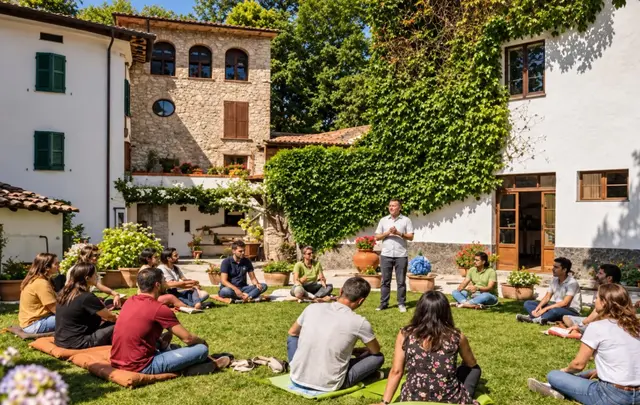
Actual photo of the property, but the people are fictional and have been added for illustration purposes.
Umbria · near MontoneClick to view the project details

LaunchPad · Borgo delle Macine

A residential campus for learning, work and community life

It can accommodate up to 50 people at once. Ready to move in.

€990,000 asking (operating agriturismo)

Single ready-made hamlet: 18 guest apartments, shared grounds, pools and sport facilities on 3.5 hectares.

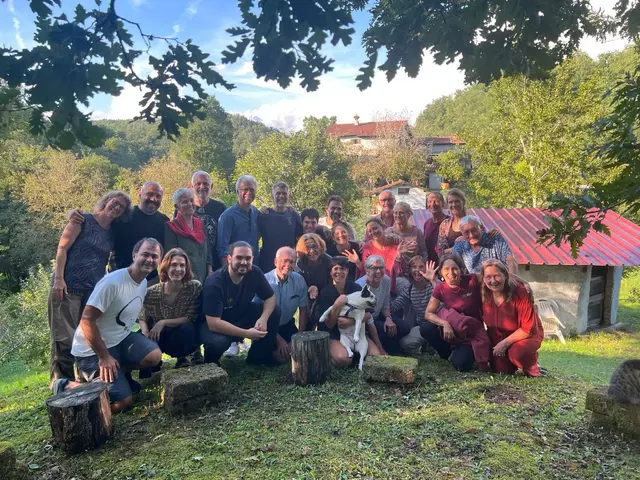
Actual location and real people.
Lunigiana · northern Tuscany–LiguriaClick to view the project details

Auroville Beyond Borders · Lunigiana hub

A distributed landing place in the Apennine foothills

Retreats have drawn ~27 people; nearby homes can host individuals. Shared hub space is still emerging.

Emerging ecosystem (multiple independent homes, not one listing)

Network of people living independently within geographical proximity, with shared projects and a collective hub function.

CompareLaunchPad · BorgoABB · Lunigiana
VisionOne campus to live, learn, work and launch livelihoods beyond Auroville.A distributed global ecosystem with physical hubs for landing and collaboration.
Property modelOne operating hamlet: 18 guest apartments across six buildings, plus a three-bedroom house in the restored mill (seven buildings in all).Ecosystem of nearby independent homes plus emerging shared hub functions.
Scale1,750 m² built · 3.5 ha · up to ~50 programme residents.Regional network; retreat drew ~27 people; growing local presence.
AffordabilityOne ~€990k purchase for the full campus (illustrative ~€20k per bed at 50 capacity, plus running costs).Lower entry per household: independent homes in Lunigiana vs one ~€990k collective purchase; region still cheaper than much of Western Europe.
Winter temperatures (January, indicative)Daytime highs about 8–11°C; overnight lows about 0–3°C.Daytime highs about 6–9°C; overnight lows about −2–3°C (often a few degrees cooler).
Climate resilience narrativeCentral Italy; established operating hospitality asset.Green, water-rich Apennine region; alternative international character.
Connection to AurovilleBuilds on lessons learned from Auroville in terms of real-world community life, governance, collective decision-making.Spirit of Auroville map → people, hubs, skills, events worldwide.

Winter climate comparison

In winter, Lunigiana is usually a few degrees cooler than the Montone area, with more frost and snow on nearby hills. Umbria stays somewhat milder on typical January days.

Indicative long-term averages for planning conversations. Confirm with local sources before acquisition decisions.

Typical January high (daytime)

8°C to 11°C

6°C to 9°C

Typical January low (overnight)

0°C to 3°C

−2°C to 3°C

Coldest nights (rough annual extreme)

Around −5°C to −8°C

Around −8°C to −12°C in valleys and hills

Frost and snow

Moderate frost; snow occasional and usually brief at hamlet level

More frost in valleys; snow more common on Apennine slopes

Winter feel

Milder, sunnier Umbrian hill days

Cooler, greener, more damp Atlantic–Alpine influence

A distributed ecosystem for carrying the spirit of Auroville into the world

Auroville Beyond Borders

Auroville Beyond Borders (ABB) began nearly three years ago as a map connecting Aurovilians and Aurovilians at heart around the world: mutual support, places to land when travelling or displaced, and familiar connections abroad.

The vision has grown into a distributed ecosystem of people, physical hubs, projects, events, skills and opportunities: both social network and practical infrastructure for a geographically distributed Auroville community.

A recent Spirit of Auroville retreat in Lunigiana, with approximately 27 Aurovilians and AVI participants, strengthened momentum for a physical hub where people can rest, regroup, meet, find work, run workshops and move onward with greater stability.

The emerging model is not necessarily one large communal property, but an ecosystem of independently living neighbours who collaborate within geographical proximity, with local people who can help with bureaucracy, language and integration.

Connection with LaunchPad

LaunchPad fits neatly into Auroville Beyond Borders’ distributed global ecosystem of physical hubs, as a potential hub with a focus on training and skills development. It offers a ready-made Umbrian campus for structured learning and community life, while ABB’s Lunigiana hub explores a lighter, distributed model for landing and connection across the wider Auroville world.

Explore Borgo delle Macine

Community board

Share, react, and follow the conversation

Share your thoughts and ideas

Sign in to post and react.

Sign in to post on the board, or message us on WhatsApp below for quick ideas.
Message us on WhatsAppwith your ideas and input!

Jump to a post

JF
Jesse Fox-Allen

And here's an image from ABB:

JF
Jesse Fox-Allen

This post is just to get the ball rolling here. Please feel free to share your ideas here. Here's one of the images from LaunchPad.